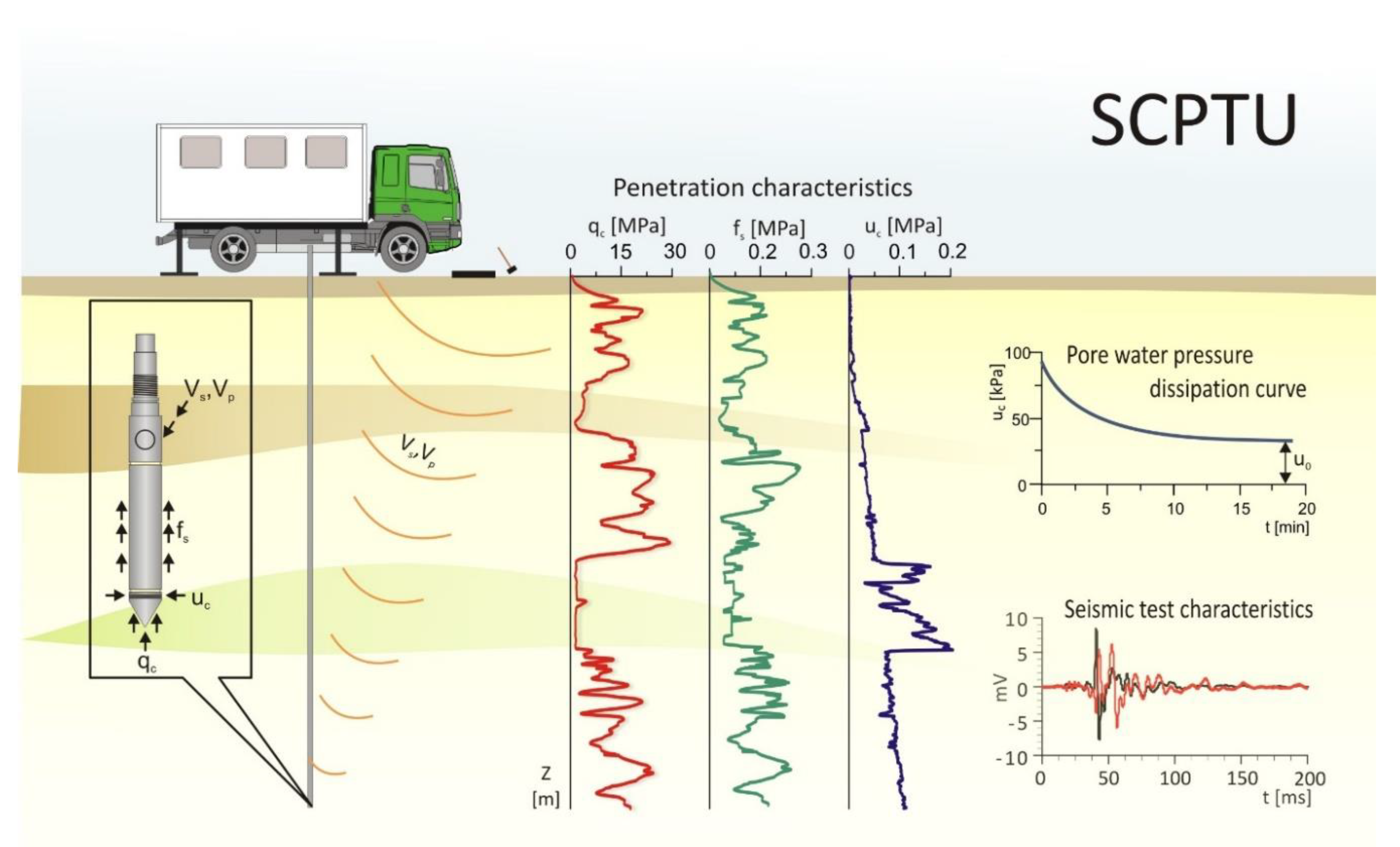
The Cone Penetration Test with pore pressure and seismic measurement (SCPTu) is an advanced geotechnical testing method used to determine the properties of soils and delineate soil stratigraphy. During the test, a cone-shaped instrument equipped with sensors is pushed into the ground at a constant rate. Continuous measurements are taken of the cone resistance (qc), sleeve friction (fs), and pore water pressure (u2). Additionally, a seismic module is added behind the probe to measure shear wave velocity (Vs), providing further insights into soil stiffness and dynamic properties. This comprehensive data helps engineers more accurately assess soil characteristics such as strength, drainage conditions, density, composition, and seismic response, making SCPTu a valuable tool to analyse the stability of tailings storage facilities, do liquefaction assessments, foundation designs, and other geotechnical applications.
The test is conducted incrementally, typically at intervals of 0.5 to 1.0 meters. A seismic wave train is generated at the ground surface using a surface-mounted anvil struck by a hammer. A triaxial accelerometer aligned in three dimensions (X, Y, Z), installed behind the piezocone is utilized to measure particle acceleration and detect the arrival of shear (s) waves during Downhole Seismic Testing (DST). Shear Wave Velocity (Vs) measurements are then used to calculate the shear modulus (G0), an indication of small strains, through further analysis.
Standards Compliance
- ISO 22476:1 (2022): Geotechnical investigation and testing — Field testing — Part 1: Electrical cone and piezocone penetration test
- ASTM D5778-12: Standard Test Method for Electronic Friction Cone and Piezocone Penetration Testing of Soils
- ASTM D7400-14: Standard Test Methods for Downhole Seismic Testing
Shear Wave Velocity (Vs) measurements
The measurements of shear wave velocity provides critical information about soil stiffness and dynamic properties