


How DPSH Testing Transformed Our Site Investigation in the Western Cape
Looking Beneath the Surface
Landfills aren’t typically known for innovation—but when it comes to building critical infrastructure on complex ground, a smart approach to site investigation can make all the difference.
Recently, we undertook a phase 1 geotechnical site investigation at a waste management facility in the Western Cape, South Africa. The site is an active landfill, designed for the disposal of general and low- to medium-hazardous waste—the types of materials that cannot be reused or recycled. Now, with the facility expanding its utility, a gas extraction plant has been proposed to harness the landfill’s untapped energy potential.
But before any foundation is laid, we needed to answer one critical question: What lies beneath?
The objective of our investigation was to assess the subsurface conditions across the proposed development area and to recommend appropriate foundation solutions based on actual ground conditions. The study involved a combination of conventional test pitting and soil profiling, Dynamic Probing Super Heavy (DPSH) testing, and laboratory analysis of selected soil samples.
While test pits gave us an initial understanding of the shallow ground, it was the DPSH testing that proved invaluable—revealing key soil strength characteristics at depth, ultimately guiding us toward a more cost-effective and reliable foundation strategy than test pits or boreholes alone could offer.
In this blog, we’ll take you through our investigation step-by-step, highlight how DPSH testing added significant value, and share some key takeaways for anyone planning infrastructure on similarly challenging ground.
Setting the Groundwork
The proposed gas extraction plant will be situated within a well-established waste management facility in the Western Cape, South Africa—an area marked by gently rolling terrain rising between 30 and 40 metres above mean sea level. The site falls within a temperate climatic zone, experiencing dry, hot summers and winter-dominant rainfall. Seasonal prevailing winds, from the southeast in summer and northwest in winter, contribute significantly to surface erosion and dust generation, which are ongoing challenges at the facility.
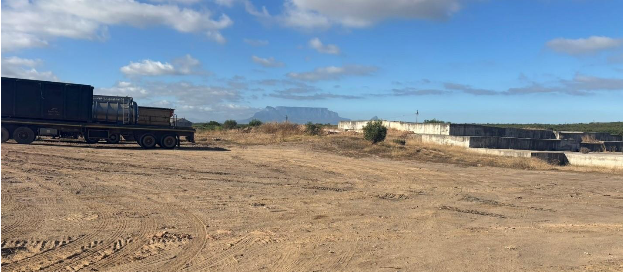
The existing site infrastructure includes a mix of active landfill cells, capped and rehabilitated areas, leachate collection and treatment systems, internal roads, and stormwater control measures. Surface water drains predominantly via sheet flow, generally moving from the southern section of the site toward the northeastern corner.
Proposed Infrastructure and Loading Considerations
The planned development comprises a large, double-storey portal-framed warehouse to support logistics and storage operations, along with smaller container-based modular structures commonly used for offices, workshops, and temporary facilities. These varying structural types result in a range of foundation loading conditions, requiring careful subsurface assessment to ensure the proposed designs are both technically viable and economically efficient.
Ground Conditions and Geology
Geotechnically, the site is underlain by light grey to pale red sandy soils of Quaternary origin, associated with the Springfontyn Formation. These sandy layers are typically loose to medium dense near the surface but may become denser with depth. Beneath this lies a more competent residual Hornfels layer, which typically offers improved bearing capacity but is highly variable in depth and strength across the site.
This geological setting, combined with the presence of man-made landfill structures and variable fill depths, presented a complex ground profile. A conventional shallow investigation using test pits alone would not have adequately captured the vertical and lateral variability—hence the need for deeper and more continuous profiling using Dynamic Probing Super Heavy (DPSH) testing.
Why We Chose DPSH: A Smarter Way to Probe the Ground
When it comes to geotechnical investigations, choosing the right method isn’t just about technical capability, it’s about balancing cost, time, and data quality. For this project, we knew from the outset that traditional test pits alone wouldn’t provide the depth or resolution needed to assess subsurface conditions with confidence, especially beneath rehabilitated landfill zones where fill depth and consistency are unpredictable.
That’s where Dynamic Probing Super Heavy (DPSH) came in.
What Is DPSH?

DPSH is a type of in-situ soil testing method that involves driving a specially designed steel cone into the ground using a standard weight dropped from a fixed height. The number of hamm
er blows required to drive the cone a fixed distance is recorded continuously with depth, giving a detailed profile of soil resistance, which can be used to estimate relative density, layer changes, and founding conditions.
Put simply, DPSH gives us a real-time look at how the soil behaves with depth—without needing to dig or drill extensively.
How DPSH Compares to Other Methods
| Method | Depth Range | Cost | Speed | Data |
| Test Pits | 1.5 – 2.5 m | Low | Fast | Good at shallow depth |
| Boreholes | 10 – 30+ m | High | Slow | High (with sampling) |
| DPSH | Up to 10 – 15 m | Low to moderate | Fast | Continuous resistance data |
While boreholes provide high-quality core samples, they are also expensive, time-consuming, and often overkill for a Phase 1 investigation—especially when the required founding depths are relatively shallow. Test pits, on the other hand, are quick and affordable but limited to shallow depths and can miss critical deeper variations.
DPSH sits comfortably in the middle—offering depth, speed, and affordability, with enough resolution to make sound engineering judgments on soil strength and suitability for foundations.
The Value of a Combined Approach
Rather than relying on a single method, our investigation combined test pitting, DPSH testing, and laboratory analysis. This hybrid approach allowed us to:
- Use test pits to visually inspect near-surface soils and collect samples.
- Apply DPSH to rapidly profile strength characteristics down to 10+ metres.
- Conduct laboratory testing to verify moisture content, grading, and classification.
This combination provided a full picture of subsurface conditions, from surface fill to deeper residual material—saving time and money without compromising on quality or the ultimate objective: designing safe and efficient foundations.
“With DPSH, we didn’t just cut costs—we gained deeper insight, faster.”
Fieldwork and Execution: Digging and Driving with Purpose
With the investigation methods selected, the next step was careful field implementation to ensure the data collected would be meaningful, representative, and reliable.
A total of eight test pits were strategically positioned across the proposed development area. These locations were chosen to capture the expected variability in ground conditions—from rehabilitated landfill zones to more natural terrain. Immediately adjacent to each pit, we carried out Dynamic Probing Super Heavy (DPSH) tests, providing a direct correlation between visual soil logs and measured ground resistance.

Test Pitting: Seeing the Soil Up Close
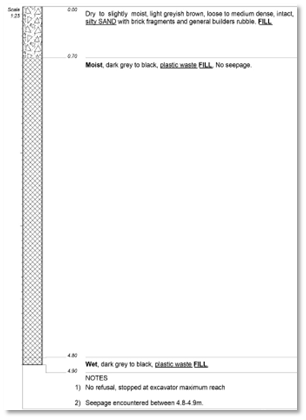
Each test pit was excavated using mechanical means to a maximum depth of 5 metres or until refusal (where the material became too hard to excavate safely or practically). The excavation and logging were performed by a qualified geotechnical engineer, in accordance with the “Guidelines for Soil and Rock Logging in South Africa”. This ensured that descriptions of soil texture, colour, structure, moisture content, and inclusions were done consistently and accurately.
These logs provided critical qualitative insight—allowing us to identify fill materials, transitions in soil horizons, and the depth to more competent residual soils, including zones of weathered Hornfels.
“Test pits helped us understand what we could see—DPSH helped us understand what we couldn’t.”

DPSH Testing: Driving for Data
Immediately next to each test pit, we performed DPSH testing to depths of between 5 and 7 metres, with one location extended to 9 metres where very stiff material was encountered and consistent penetration resistance data could still be obtained. The proximity of the DPSH tests to the pits was intentional—it allowed us to directly validate the visual soil profiles with quantitative penetration resistance data.
DPSH testing was carried out using a standard rig and drop weight system, in line with SANS and ISO procedures. The blow counts were recorded at 300 mm intervals, giving a continuous strength profile with depth. These readings allowed us to infer bearing capacity and estimate founding depths, especially in areas where the fill material was deep or highly variable.
In several locations, the DPSH data revealed stiff underlying layers that were not obvious from visual logging alone, particularly valuable in identifying suitable founding strata beneath layers of loose or variable landfill fill.
Working Efficiently on a Complex Site
Despite the operational challenges of working within an active waste management facility—including traffic from heavy vehicles, dust control, and access limitations, the team was able to complete all fieldwork efficiently, thanks to the compact nature of the DPSH rig and careful coordination with site management.
This fieldwork phase not only met the investigation’s technical objectives but also stayed within tight time and budget constraints—laying the groundwork for the next stage of analysis and engineering decision-making.
Results and Geotechnical Evaluation of the Site
Understanding the subsurface profile is critical for determining appropriate foundation solutions, especially on a working landfill site where the presence of fill material and variable stratigraphy can introduce uncertainty. The combination of test pitting, Dynamic Probing Super Heavy (DPSH) testing, and laboratory soil analysis allowed us to develop a high-confidence geotechnical model for the proposed gas extraction infrastructure.
DPSH Results, Site Stratigraphy and Classification

The site is predominantly underlain by heterogeneous fill, extending to various depths, underlain by residual silty clay derived from Hornfels, and in some areas transitioning to very soft rock Hornfels.
DPSH testing provided invaluable quantification of in-situ stiffness and relative density. Trends across the site clearly reflect two distinct geotechnical zones. These zones were adopted to streamline foundation recommendations.
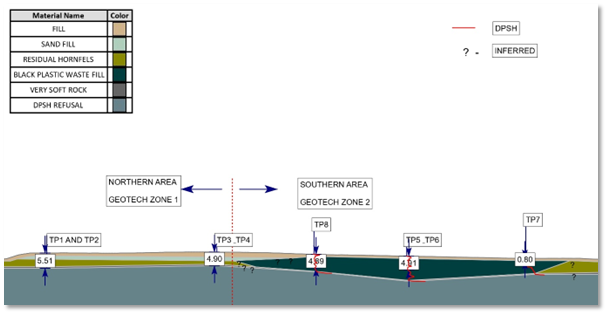
The site was divided into two geotechnical zones based on the depth and composition of the fill layer:
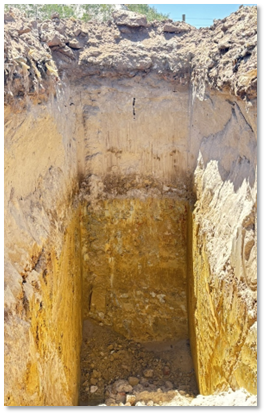
ZONE 1
Located in the northern portion, characterized by a thinner fill layer (typically <1.5 m), underlain by residual silty clay. This zone supports shallow foundations

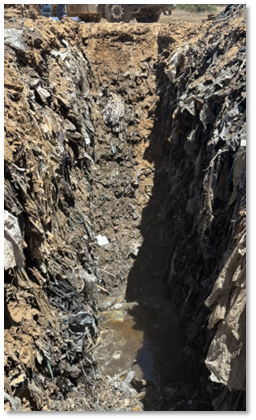
ZONE 2
Dominates the southern half, where the fill layer ranges from 1.0 m to over 9.0 m in thickness. This fill consists of plastic waste and rubble, deemed unsuitable for shallow foundations due to low strength and high compressibility.
A conceptual longitudinal stratigraphic profile illustrates the division between these zones.
Excavatability and Soil Behavior
Soil excavability was classified according to SANS 1200D guidelines:
- Zone 1: Shallow excavation into fill and residual Hornfels is classified as “soft” (0–1.5 m), transitioning to “intermediate” (up to 3.4 m) due to stiffer silty clays and partially weathered rock.
- Zone 2: Dominated by soft excavation throughout, thanks to the significant depth of loose plastic waste and sand fill.
No groundwater or perched water table was encountered in Zone 1, whereas Zone 2 exhibited signs of seepage, attributed to the permeability of the plastic waste fill.
Foundation Design Recommendations
Zone 1:
- Shallow foundations are viable.
- Residual silty clay exhibits low expansiveness and favorable bearing capacity.
- Using Brinch Hansen’s method (1970), a safe load of 342 kN for a 1×1 m square footing was confirmed, providing an operational Factor of Safety (FoS) of 3.
- The soil supports foundation pressures up to 350 kPa, making it suitable for modular and light industrial infrastructure.
Zone 2:
- Fill extends from 1.0 to 9.0 m, with poor stiffness and signs of seepage and plastic degradation.
- Shallow foundations are not recommended.
- Deep foundations, such as driven piles or drilled piers, are required. Caution is necessary to avoid environmental risks from contaminant migration.
- Any concrete or steel structures must account for potential depassivation due to seepage interacting with waste layers.
Environmental and Durability Considerations
- The migration of contaminants from the plastic-rich fill in Zone 2 must be managed during deep foundation design.
- Materials in contact with this fill layer must have appropriate durability protection, including corrosion-resistant coatings or barriers.
- Concrete mixes should be designed to resist aggressive chemical environments that may be introduced via leachate or landfill gas.
In conclusion, the combination of DPSH and test pitting allowed for a detailed zoning of the site and informed cost-effective, safe, and tailored foundation solutions for each area. Rather than relying solely on traditional test pits, DPSH testing provided deeper insights, particularly in characterizing stiffness and identifying unsuitable zones, making it an invaluable addition to the geotechnical toolkit.
Reflections and Recommendations
Reflecting on this investigation, several key lessons emerged:
- DPSH is a valuable complement to test pitting, especially where fill materials may obscure deeper transitions or where visual classification is limited by variability and plastic content.
- In landfill-adjacent or reclaimed sites, site investigation should always anticipate deep, inconsistent fill zones—even when surface conditions appear uniform.
- The ability to quickly deploy and repeat DPSH tests across a site made it more efficient than drilling, particularly in budget-conscious or access-restricted environments.
- For future projects, we recommend:
- Early combined use of in-situ testing (DPSH/CPT) with trial pits, rather than relying on one method alone.
- Including chemical testing of seepage water and adjacent soil in areas with known or suspected waste infiltration.
- Continuing to develop geotechnical zoning diagrams to inform modular or phased construction layouts.
Conclusion
The geotechnical investigation successfully characterized complex fill and residual profiles on a challenging brownfield site. The dual-method strategy—leveraging DPSH testing alongside test pitting—provided a cost-effective, detailed understanding of subsurface conditions.
This approach allowed the engineering team to:
- Confidently zone the site into areas suitable for shallow vs deep foundations;
- Accurately assess bearing capacity and soil stiffness;
- Identify areas of potential chemical aggression and seepage;
- And most importantly, de-risk the foundation design by aligning it closely with actual ground behavior.
This project underscores the value of blending traditional geotechnical methods with rapid, high-resolution tools like DPSH in complex environments. It is a model worth repeating for similar landfill-adjacent or reclaimed development sites.